Basic TaeKwon-Do Information
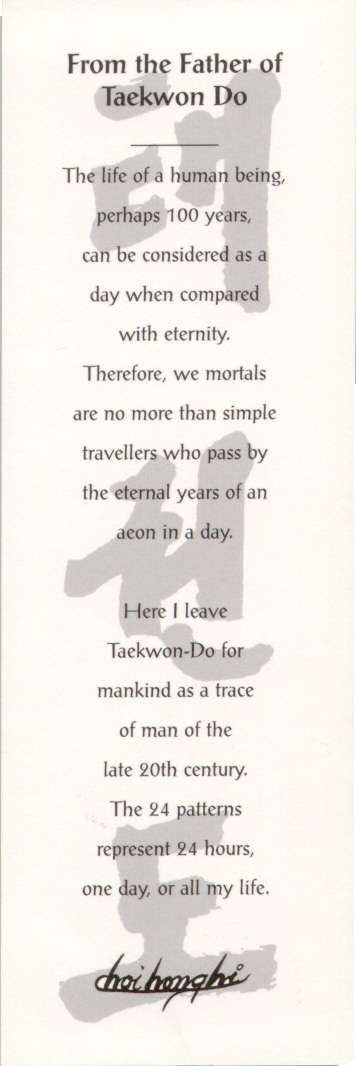
TaeKwon-Do is one of the newest martial arts in the world. It was created in the late 20th century by General Choi Hong Hi (1918-2002) from Pyongyang, North Korea, who is considered the father and inventor of TaeKwon-Do. General Choi Hong Hi is also the founder of the ITF. It is with great sorrow that we mourned his passing (June 15, 2002) but we strive to make sure his legacy will live on!
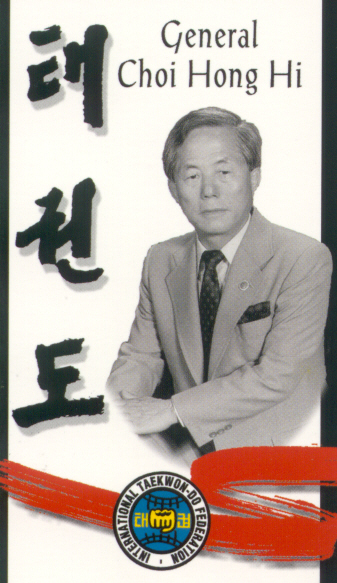
Some of the instructors in this class had the opportunity to practice TaeKwon-Do with the General - in fact, his last International Instructor's Seminar was held right here in Colorado in April, 2002...just two months before his death. Grand Master Hups had a strong relationship with the General over many years and was lucky enough to have called him "friend".
The literal translation of TaeKwon-Do follows:
- Tae: Jumping, flying, to kick or smash with the foot.
- Kwon: Fist, to punch or destry with the hand or fist.
- Do: The art or way.
TaeKwon-Do, as we practice it, consists of four distinct disciplines. These are: patterns, foot and hand techniques, step-sparring, and Ho Sin Sul self defense. As a student progresses through the different belt levels, these disciplines become increasingly more challenging. To advance to new levels of challenge, a student must demonstrate proficiency in his/her techniques at the existing level. You can find more about our testings under Class Info.
In TaeKwon-Do, there are two belt classifications, colored belts and black belts. Within each of these classifications, there are several levels of expertise. Each level must be mastered before advancing to the next level. The belt levels and their meanings follow.
White Belt
Yellow Belt
Green Belt
Blue Belt
Red Belt
Black Belt (Black belt testing check list)